


Why the North Seas are central to our energy story


North Seas cooperation explained
This page provides an overview of the world-leading wind resources and pivotal role of the North Seas, as well as how cooperation between the UK and its European neighbours can enable the region to become Europe’s green power plant and deliver resilient net zero energy systems for decades to come.
Find out about
How do we transition from a fossil fuel past to a renewable future?
Transitioning from a fossil fuel-based system to one based on clean, affordable and sustainable energy is essential not only for protecting our environment and health, but for providing a pathway to industrial growth, innovation, long-term economic stability, and energy security.
Thanks to the rapid development of clean energy, the UK has undergone a remarkable transformation in its reliance on fossil fuels. As the economy expanded in 1950s, fossil fuels accounted for 97% of our total energy supply, but this fell to around 70% in 2010 and was down to 32% in 2024.
In 2019, the UK became the first major economy to introduce a legally binding target to bring greenhouse gas emissions to net zero by 2050, aiming to achieve a greener, more sustainable future. And in 2024, the UK’s last coal-fired power station was closed, proving once again that the Government is committed to achieving clean power. The same year, renewables generated a record 50.4% of the UK’s electricity, marking the first time they provided more than half of the country’s power, while fossil fuel–based generation fell to a record low of 31.5%.
The UK has also experienced a significant shift in its energy sourcing: since 2004 the UK has been a net importer of energy, until it became a net exporter in 2022. This proves that homegrown power is a step towards energy security, and the UK has the potential to become a clean energy powerhouse, generating more than enough renewable electricity to meet domestic demand, boost exports, and drive green growth across the economy.
Renewable energy offers the cleanest, most sustainable and reliable replacement for fossil fuels. These types of abundant clean energy sources emit no greenhouse gases and are available all around us.
We need to build upon this progress by continuing to use renewables as an opportunity to revitalise our economy, whilst reducing our emissions and ultimately achieving net zero by 2050, as legislated by the Government.
In order to do this, we must change the way in which we plan our energy system and energy infrastructure. Significant investments will be needed to move away from fossil fuels and accelerate the deployment of renewable energy through clean technologies, such as wind and solar farms, hydro power and geothermal energy.
What is the UK’s wind energy potential?
The UK has incredible wind potential, which it is already beginning to harness. When it comes to offshore wind, the UK is a global leader, second only to China, with a current operational capacity of 16.1 gigawatts (GW), 11.5GW under construction and a further pipeline of 65.3GW. The total operational capacity for onshore wind stands at 15.9GW, with 1.9GW under construction, and a further pipeline of 29.4GW. For context, every GW of new offshore wind provides enough electricity for around one million UK households.
Offshore wind has been identified by the Government as playing a crucial role in delivering clean power by 2030, as published in the Clean Power 2030 Action Plan. The ambition is to install 43-50GW of offshore wind and 27-29GW of onshore wind, significantly reducing our fossil-fuel dependency, as well as to develop a flexible electricity grid that can accommodate the increased capacity of clean energy sources.
As a clean, reliable source, offshore wind has the potential to generate more power compared to onshore wind thanks to stronger and more consistent wind speeds at sea, larger turbine sizes, and the ability to install projects at greater scales in open waters.
Whilst there are good inland wind resources across the UK, the North Seas should play a key role in enabling offshore wind deployment and realising the Government’s target of 43-50GW by 2030.
Why are the North Seas key enablers of the energy transition?
The North Seas – defined here as the North Sea, Celtic Sea and Irish Seas - are widely considered Europe’s energy powerhouse. Over the last 60 years, the North Seas’ oil and gas industry has supported economic growth and energy security for all the surrounding countries, such as Norway, Germany, France, Denmark, the Netherlands, Belgium and the UK.
But equally, the North Seas provide optimal conditions for offshore wind development due to their consistently strong winds and shallow waters. By virtue of this, they have the opportunity to maintain a central role in a future clean energy system - securing Europe’s energy independence, but with new natural resources. The UK has already begun to capitalise on its resources by leading the world in offshore wind deployment, hosting the three largest operational offshore wind farms globally.
The UK Government has put forward a vision of the North Sea’s Clean Energy Future, built around three objectives reflecting its recognition of the North Sea’s vast potential to deliver benefits for citizens, communities, and the economy:
- Positioning the UK as a global leader in offshore clean energy industry by creating long-term quality jobs and investment in local communities.
- Ensuring a just transition for oil and gas workers and supply chains.
- Aligning all decisions with climate science.
This progress demonstrates how the North Seas can be transformed from heavy fossil fuel production into a renewable energy hub, whilst continuing to support local economies and communities. The offshore wind sector is already a British success story as it is Europe’s biggest offshore wind market. Alone, this sector has delivered nearly 40,000 jobs and generated more than £2bn in annual exports in the UK, as presented in the UK Offshore Wind Supply Chain Investment Guide published in 2025. The UK Government estimates that, by 2030, the offshore wind sector has the potential to create a further 14,000 jobs and drive up to £9 billion of private funding.
How are countries collaborating toward common clean energy goals?
The UK is physically connected to its neighbours through gas pipelines and electricity interconnectors (subsea high-voltage cables). Interconnectors allow electricity to flow between countries depending on where this is needed the most. For example, if the UK has surplus renewable energy on windy and sunny days, it can export this to its neighbours. Currently, Great Britain has ten operational electricity interconnectors with a total capacity of 10.5GW, which is expected to increase to over 18GW by 2032.
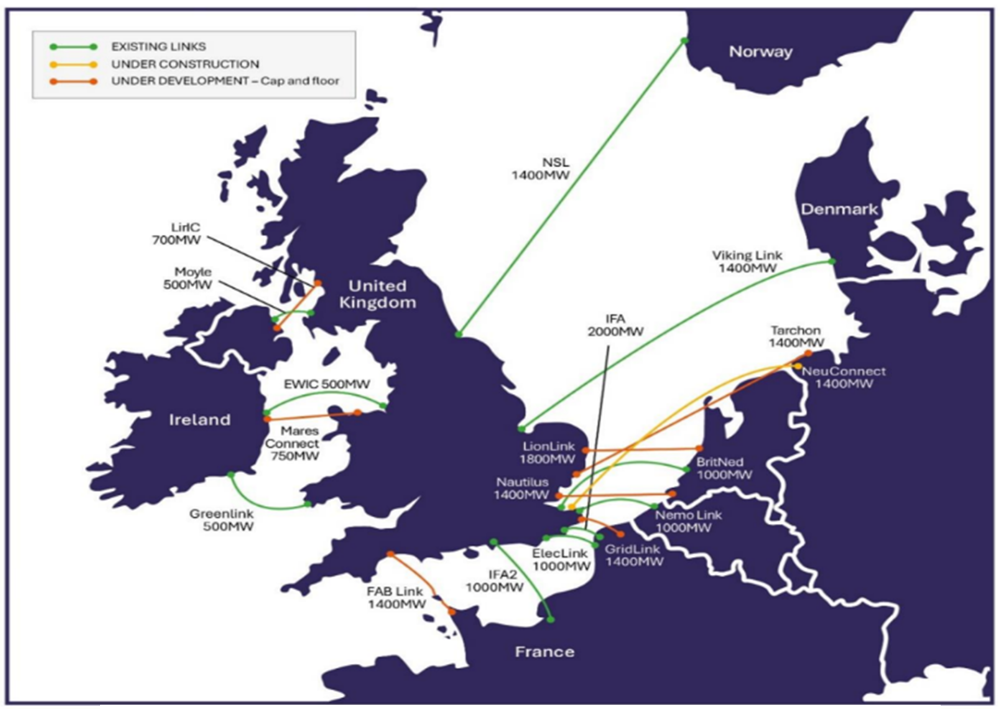
The UK and its European neighbours share not only infrastructure but common energy and climate goals, and so they are actively working together through various bilateral energy partnerships, such as the North Sea Summits and the North Seas Energy Cooperation (NSEC).
The North Sea Summits are high-level political events that set the direction, maintain political momentum and demonstrate commitment of the North Seas countries. North Sea Summit I took place in 2022 in Esbjerg, Denmark, and was attended only by Belgium, Denmark, Germany, and the Netherlands – which also signed the Esbjerg Declaration. North Sea Summit II took place in 2023 in Ostend, Belgium, when the coalition expanded to France, the UK, Ireland, Norway, and Luxembourg. Through the Ostend Declaration, these countries have set ambitious combined targets for offshore wind of at least 120GW.
While the North Sea summits set the goals, the NSEC looks at the technical aspects of how to achieve them. It is a key regional non-binding cooperation framework that strengthens collaboration on offshore energy and hydrogen development in the North Seas, which includes the North, Celtic and Irish Seas.
The NSEC focuses on coordinating offshore infrastructure, identifying joint projects, and designing supportive financial mechanisms to accelerate the deployment of cross-border clean energy solutions in the North Seas. The NSEC is an initiative by the European Commission that has been in place since 2008. The UK was part of NSEC prior to leaving the EU and it partially re-joined it by signing a memorandum of understanding in October 2022. Other members of the NSEC include Belgium, Denmark, France, Germany, Ireland, Luxembourg, the Netherlands and Norway.
Delivering at least 300GW of offshore wind by 2050 is an ambitious target which could generate more than enough clean electricity to power all households across the North Seas countries. Achieving this will require efficient offshore grid infrastructure planning, strong cooperation and coordinated investment. A well-designed offshore grid will allow power to flow efficiently between countries, ensuring that renewable energy is used where it is needed most and waste is avoided during times of surplus generation. As we share the same seabed, it is also imperative to work together to protect our marine ecosystem and fisheries through joint marine spatial planning.
Looking ahead, stronger collaboration between the North Seas countries will be needed to maximise their potential and turn the region into Europe’s green powerplant. By expanding offshore wind capacity, investing in interconnected grid infrastructure, and integrating innovative technologies, the North Sea region can strengthen both the EU and UK energy security, reduce dependence on imported fuels, and accelerate the path to net zero.
How can cooperation enhance benefits across the North Seas?
Closer collaboration on shared infrastructure and cross-border electricity trade will not only lower costs for consumers and improve reliability of the energy system, but will also decrease system costs by avoiding duplication and inefficiencies.
Several studies have highlighted the socio-economic benefits of greater cooperation with our North Sea neighbours. For example, a study published by Grant Thornton for the Department for Energy Security and Net Zero (DESNZ) found that developing coordinated energy infrastructure across the North Sea could bring around £24.3 billion in system benefits and £18.3 billion in consumer benefits by 2050, a far better outcome than if the Governments made no further policy interventions and continued with the existing fragmented approach.
In addition, the study estimates that over 100,000 new direct jobs could be created in the UK across the supply chain by 2050, with even more opportunities expected through additional indirect and induced employment. This figure includes jobs across three sectors: offshore wind, hydrogen, and carbon capture, usage, and storage (CCUS).
Equipping young people with the right skills and re-skilling the existing oil and gas workforce will be vital. Research published by Robert Gordon University in 2023 shows that more than 90% of current oil and gas workers have skills that are directly transferable to other energy sectors. The same study also estimates that the offshore energy workforce alone could generate around 138,000 jobs in the UK. North Seas cooperation helps to retain valuable expertise in the region and ensures that local communities benefit from new opportunities in the clean energy economy.
What does the future of offshore wind look like?
While we are building a strong and adaptable workforce, we must also look ahead at the next phase of offshore wind by investing in new technologies and innovations. Energy islands, offshore hybrids and other technologies will be central to unlocking even greater potential in the North Seas and ensuring that clean energy is delivered across the region through coordinated and efficient planning.
Currently, most offshore wind farms are connected directly to land through individual radial cables. A more innovative approach would be to link offshore wind farms to multiple countries via interconnectors, creating what is known as an offshore hybrid asset. This setup allows electricity to be transmitted flexibly to whichever country needs it most, without interrupting generation. The UK has the capacity to become a net exporter of electricity, particularly when domestic wind power generation is high, and the National Energy System Operator (NESO) has forecast that it will become net exporter by 2030.
Interconnectors and hybrid cables, linking the UK to other European countries, are vital for both importing electricity when domestic generation is low and exporting it when we have a surplus.
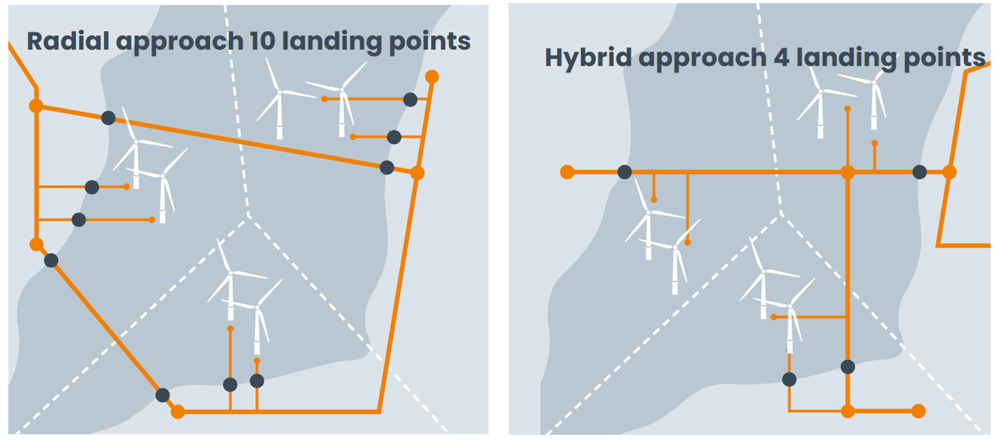
Offshore hybrids bring several advantages, including:
- reducing the need for multiple separate grid connections to shore
- cutting overall infrastructure costs
- making the best use of renewable energy by enabling cross-border electricity trade.
They also strengthen our energy security by balancing supply and demand across regions and helping accelerate the integration of large-scale offshore wind into the broader energy system.
Given the complexity behind offshore hybrid assets, there is only one asset currently in operation worldwide — the Kriegers Flak Combined Grid Solution – linking offshore wind to both Denmark and Germany.
The UK has several offshore hybrid assets in planning, such as LionLink connecting offshore wind with the Netherlands, HansaLink connecting offshore wind in Scotland to Germany, and Nautilus connecting the UK to an energy island in Belgium. These will become some of the first large-scale offshore hybrids in the world, powering almost 6 million homes in the UK when they become operational in 2032.
Similarly to offshore hybrids, energy islands are artificially built islands that act as central energy hubs for multiple offshore wind farms, before feeding electricity to multiple countries. They can also host various technologies, such as hydrogen electrolysers, converter stations, solar panels and energy storage.
As complex as this can be to deliver, Belgium is already working on constructing the world's first energy island: the Princess Elisabeth Energy Island, located 45km from the coast and connecting both the British and Danish grids. The Princess Elisabeth Energy Island is an important first step towards a future integrated offshore electricity grid, and a testament to the blossoming cooperation between the North Seas countries.
What happens next?
With world-leading wind resources and a pivotal role in the North Seas, the UK has a unique opportunity to strengthen energy security, cut emissions, and drive long-term economic growth.
Realising this potential will depend on continued investment in offshore wind, modern grid infrastructure, skills and innovation, alongside deeper cooperation with our neighbours. By working together across borders, the North Seas region can become Europe’s green power plant and play a central role in delivering resilient net zero energy systems for decades to come.