


Daniel Sutherland, EnergyPulse Analyst and Max Bradbury, EnergyPulse Data Manager
23/01/2026 | Onshore wind

UK wind energy pipeline in 2025: a year in review
EnergyPulse blog - 23 January 2026
2025: a record year for UK wind energy
2025 was yet another record-breaking year for wind power in the UK, providing enough electricity for 80% of the UK's homes on the windiest winter days. The year gone also saw the UK mark 25 years since the first offshore wind turbines were installed in UK waters.
Behind these good news stories there's been a steady growth of new projects, with the UK adding approximately 1531MW (1.5GW) of new capacity and record amounts of capacity entering construction and planning. Now firmly into the new year, in this blog, we review the state of the UK's pipeline across onshore and offshore wind over 2025, and provide updated forecasts on capacity growth in the future.
Related content
UK onshore wind
Projects coming online
In 2025, the total operational capacity of onshore wind in the UK reached approximately 15.9GW, adding 201MW during the year, the majority through the commissioning of Boralex’s Limekiln (106.5MW) and the repowering of Scottish Power’s Hagshaw Hill (79.8MW). Other projects including Cenin Renewable’s Llwyncelyn Farm (5MW) and Alaska Wind Farm (8MW). Projects nearing completion that have reached a partially operational status (not included in the total) amount to around 350MW of capacity, including North Kyle, Corlacky, Benbrack and Stathallan.
Projects under construction
Nearly 950MW of capacity entered construction in 2025 across 11 projects. Most notably, Community Windpower’s Sanquhar II (270MW), having received consent in 2023. Sanquhar II is slated to feature 44 Vestas turbines with tip heights up to 200m. Also starting construction activities in 2025 is the Stathy South wind farm on the Scottish Highlands. Owned by SSE Renewables, the project will have a capacity of 208MW and operate 35 turbines. Extension projects also began construction in 2025, the Arecleoch and Kilgallioch extension projects both commenced construction activities in June, with Farrans contracted for the balance of plant for ScottishPower Renewables on both projects.
Projects in planning
Over 4.4GW of capacity was submitted to planning authorities in 2025 in the UK across 135 projects, nearly double the number of projects submitted in 2024. Scotland remains the select location for onshore wind submissions, boasting 92% of capacity submitted for a planning decision in 2025. After a fall in capacity submitted in 2024 year on year, 2025 saw the highest capacity put forward for planning on record, approximately 1.3GW more than was submitted in 2023 (the previous record). Some of the larger scale project submitted for planning include the Dorenell Extension (497MW), Cnoc Buidhe (300MW) and Mid Hill (270MW). A highlight in 2025 was the submission of Scout Moor II, a 100MW 17 turbine project planned to the north east of Scout Moor. Planning documentation was submitted in July to Rochdale Borough Council with EnergyPulse forecasting a decision by 2028.
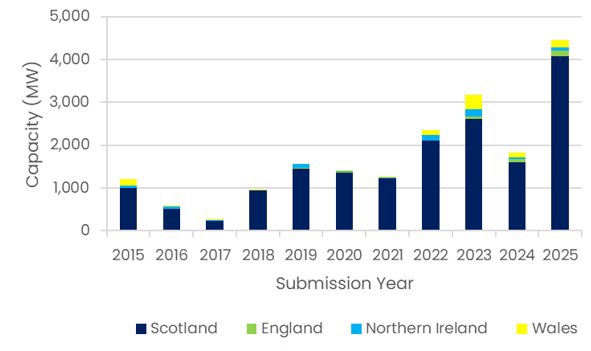
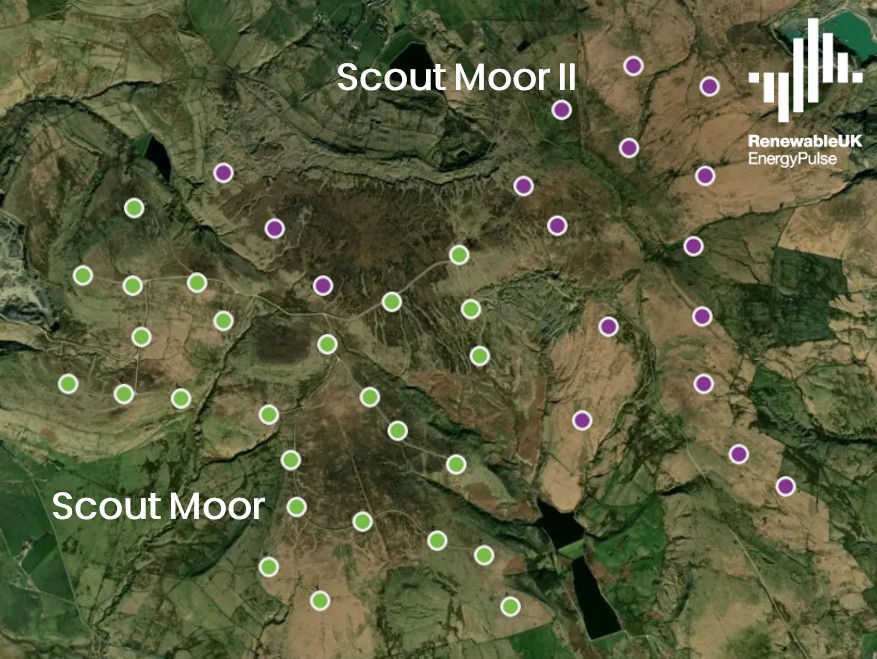
Figure 3: Project in focus: Locations of turbines for the planned Scout Moor II wind farm (purple) next to the original Scout Moor wind farm (green). Visualised using the EnergyPulse turbine locations dashboard, available to RenewableUK members.
Figure 1: Map of onshore wind farms commissioned in 2025, partially operational and under construction projects in UK. Visualised using the EnergyPulse dashboards available to RenewableUK members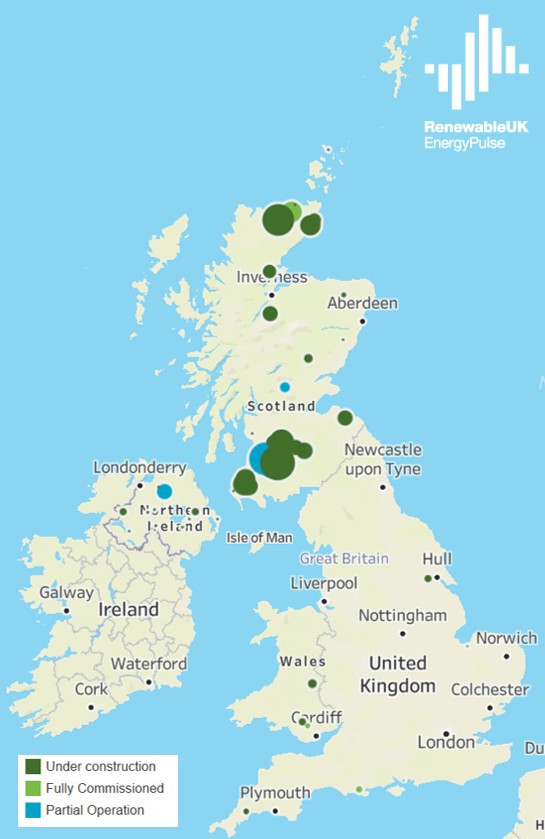
Forecast
According to the EnergyPulse forecasting model [1], the UK is now set to achieve 23GW of onshore wind by 2030 (last year EnergyPulse forecasted 26GW of onshore by 2030, this could be due to the relative lack of submissions in 2024 or other various factors that contribute to the modelling). The EnergyPulse forecast currently predicts the UK onshore wind capacity to reach 30GW by 2033.
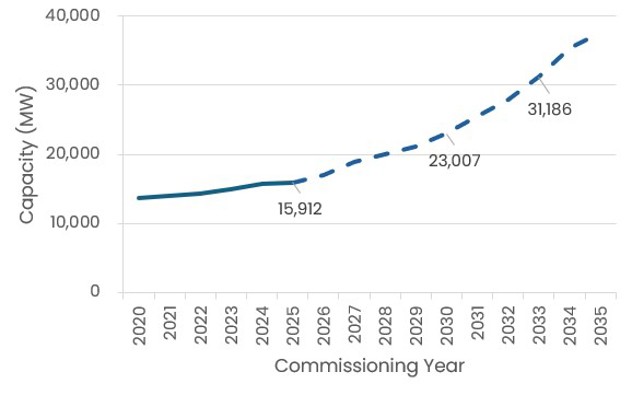
Figure 4: EnergyPulse forecast of UK onshore wind capacity
With the positive AR7 results for offshore wind in the UK, the onshore sector will be hoping to follow suit with results to be announced in early February 2026.
Securing strong capacity numbers, credible strike prices, geographic spread and proof of deliverability would lead to political credibility, investor confidence and progress towards the UK’s clean power goals, creating a diverse, competitive and resilient clean energy sector.
UK offshore wind
Projects coming online
The UK’s operational offshore wind capacity currently stands at 16,061 MW. After a quiet 2024, in which no projects reached full commercial operation, 2025 was a rebound.
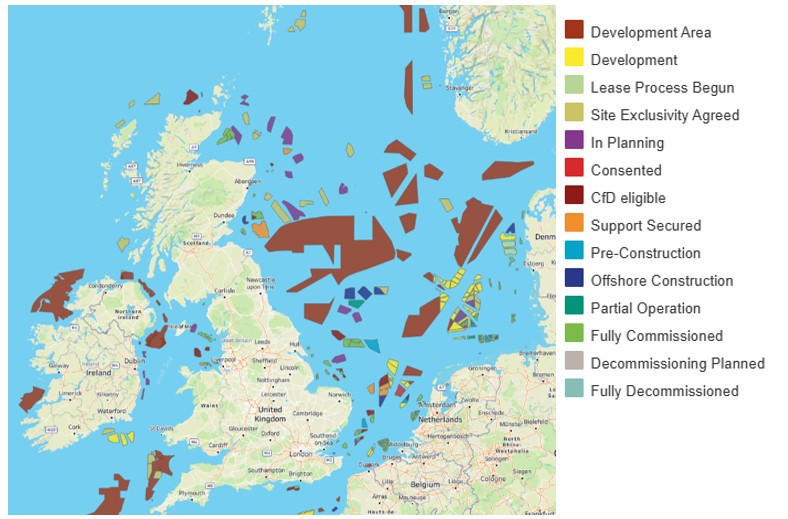
Figure 5: Map of UK offshore wind projects at various stages of development, including development areas, viewed on EnergyPulse dashboards available to RenewableUK members
Two projects, Moray West (Ocean Winds 95%, Ignitis 5%) and Neart Na Gaoithe (EDF 50%, ESB 50%), achieved full commissioning during the year, adding a combined 1,330 MW.
Neart Na Gaoithe’s completion was particularly notable, following a challenging development journey. The project faced the withdrawal of its planning consent and CfD after a 2016 legal challenge, a change of ownership in 2018, and vessel availability constraints during turbine installation, all contributing to significant delays.
Projects under construction
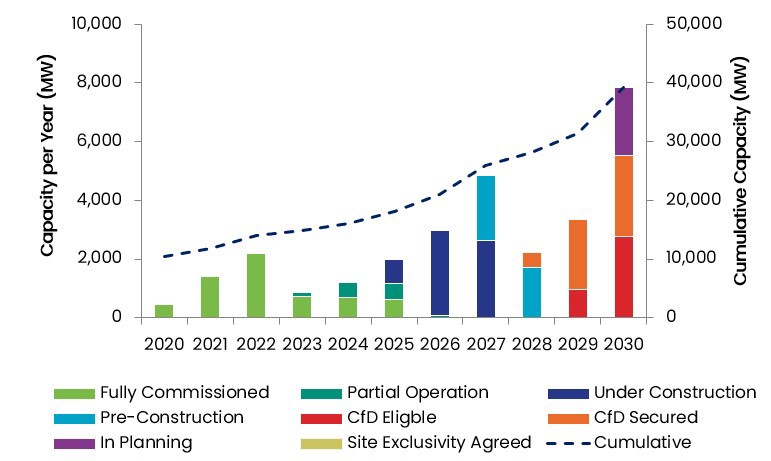
A glut of projects under construction are setting the stage for record commissioning activity in the immediate future. At the end of 2025, nine projects, representing 11,500 MW were undergoing construction activities. Six of these (7,582 MW) undergoing offshore construction and three projects (3,918 MW) undergoing onshore and preliminary offshore construction activities. All of these projects have are planned for completion between 2026 and 2028, with 2.6 GW to be completed in 2026. These include the first floating wind project to be constructed in the UK since Kincardine (2021), Culzean, which is expected to be operational by the summer of 2026.
Offshore constructions milestones in 2025
|
Project |
Capacity |
2025 milestone |
| Dogger Bank A |
1,235 MW |
93 of 95 turbines installed by year-end. |
| Dogger Bank B & C |
2,453 MW |
All foundations and transition pieces installed. Second turbine installation vessel joining in 2026 to speed up installation. |
| Sofia |
1,400 MW |
Final monopile installed and 65 turbines installed by year-end. |
|
1,397 MW |
Export cable and foundation installation commenced, offshore converter installed. |
|
| Inch Cape |
1,080 MW |
First export cable installed. Foundation installation began in December. |
| Hornsea 3 |
2,955 MW |
Foundation fabrication and seabed preparation underway. |
| East Anglia 2 |
960 MW |
Early fabrication underway. |
| Culzean |
3 MW |
Onshore assembly near complete. |
Projects consented
In terms of consenting activity in 2025, the year was quieter than 2024. Four projects, all planned as floating offshore wind developments in Scotland, submitted Section 36 offshore planning applications, representing a combined 4.3 GW of capacity.
Nine projects, totalling 12.1 GW, received planning consent during 2025 (including 1.5 GW from Morgan, which was subsequently cancelled in 2026). Of this consented capacity, 4.4 GW was in England (Five Estuaries, Morecambe, Morgan, Rampion 2 and White Cross), 6.2 GW in Scotland (Berwick Bank, West of Orkney and Salamander), and 1.5 GW in Wales (Mona). By the end of 2025, 17.4 GW of offshore wind capacity was awaiting determination.
Forecast
EnergyPulse forecasts that UK offshore wind capacity could reach 39.3 GW by the end of 2030 on current trends, including capacity from partially operational projects, with 34.6 GW coming from fully commissioned capacity. This total includes up to 1 GW of floating offshore wind, although a significant share depends on a small number of projects currently targeting completion in 2030. Achieving this level of capacity by the end of the decade will require an accelerated AR8 timeline, which will allow up to 2GW from the most advanced projects that have yet to secure a CfD to reach operation before 2030.
Stay tuned for the EnergyPulse global offshore wind 2025 in review, coming soon.


Methodology
This blog consists of analysis and forecasts of project milestones, capacity, turbine numbers, and ownership for UK onshore wind farms greater than 100kW in size. All data is sourced from publicly available information.
Where real dates and values are known, they are represented in the data. Unknown dates and values are modelled using assumptions and trends derived from the installed base of UK onshore wind projects. Our model uses historical data trends including the time taken for a project to receive a planning decision, length of appeal, time from consent to construction and time taken to construct and commission. The data is refined by project size and geography where appropriate. Every effort has been made to present the most up-to-date information obtainable prior to publication. Projects in planning or early-stage development are assumed to receive consent. Valid consented projects are modelled as always being built.
[1] Our forecasting model does not make any assumptions on the timing of commissioning where there are conditions attached to a consent that relate to aviation constraints or Eskdalemuir exclusion arrangements. Where an estimated grid connection date is known then this is used to refine the timings of the model.
Projects that have received a planning consent, but according to our research have not been progressed to construction by the date stipulated in conditions of a consent, are not include in projections of future capacity or the totals of consented projects used throughout the blog unless otherwise stated